Showing posts with label code. Show all posts

Thursday, December 4, 2008

JavaFX More Popular Than Even Sun Expected

JavaFX1.0 is out. Go play with it. Evidently, everyone else already has.
This morning, when Sun Microsystems opened the doors on its packages of JavaFX 1.0, developer suite and all, the servers buckled. Seems like even Sun had low expectations for this seemingly also-ran RIA/presentation layer language. Either that, or something is dreadfully wrong with this infrastructure company that can't keep its infrastructure running at top speed.
Tonight, Sun held a little soiree at Temple in San Francisco, where they had partners and pedagogues extolling the virtues of this new Java-like whiz-bang. After hearing all of the same things from Sun, I went after some of the partner programmers who were on hand, demonstrating their decidedly multi-media-centric creations.
And after speaking to Lucas from EffectiveUI, I'm convinced that this may not be a complete disaster. He'd worked with Flex, as EffectiveUI is primarily focused on Webish RIAs. In his opinion, the animation capabilities in JavaFX are fantastic. Some of the backside is still a little warty, but if you've already got a Java-based Web infrastructure, he said that this is better than Swing. He said he was an old-hand at Swing, and acknowledged that there were amazing things that could still be done with it. But the way he described it, he prefered handling user interfaces and graphics in JavaFX.
That alone is enough to make this worth taking a look at. Most of the world felt the same way, because Sun's servers were crippled today, slowing to a snail's pace as everyone and their siblings sucked down the fresh binaries.
Dan Ingalls, of Lively Kernel fame, was also on hand, demonstrating the latest level of meta: Lively kernel running on top of JavaFX. He then created the world's first Wankel Rotary Piano by tying a keyboard widget to a demonstration of the afforementioned motor. Not really sure how any of Dan's work will make Sun money, but it's great to see him creatively enabled. The man and his team are artists.
My only complaint about everything I saw tonight: slow. Sun obviously has some optimization work ahead of it. Every JavaFX demo from the company shows off 9 streaming HD videos playing at once. Then they focus in on one, and it gets choppy. Great, you can play 9 movies at once. Can you play any of them fullscreen without dropping half the frames? I'm not sure because they never show less tan 9 videos running at once. I would simply like to see for myself that JavaFX can play one HD movie without getting choppy. Some of the demos were choppy too. A tad worrying, but I'm sure it will only get faster.
Hats off to Sun. Looks like everything went right this time. Now the hard part: beating Adobe and Microsoft.

Wednesday, November 19, 2008

JavaFX Will be Here Soon


Sun's answer to Flex and Silverlight will arrive in the first week of December. JavaFX, formerly JavaFX Script, is set to hit version 1.0 shortly after Thanksgiving, said a spokesperson with the company. Things at Sun are a bit chaotic right now, and the release may be delayed by as much as a week if things don't come together properly. This, evidently, has less to do with the technology than it has to do with the major changes in management throughout the company. Either way, the release itself will take the form of a new installer for Java.

That new installer isn't too different from the old one: it's the basic JavaSE desktop runtime with the JavaFX libraries included. Users who already have Java installed should be able to automatically pull those packages down upon the reception of a JavaFX application embedded in either a desktop or Web app.

NetBeans is the editor of choice for dealing with JavaFX, and this morning's release of version 6.5 quietly included all of the JavaFX tooling. No patch needed.

The big selling point for Sun, right now, is that JavaFX can run browser applications and desktop applications on the same runtime. Adobe's current schizoid approach with AIR, Flex and Flash could turn out to be an Achilles heel, if you believe Sun's pitch.

The benefit to developers is less understood at the moment, because, as usual with Sun, this type of thing is entirely new. The application benefits will have to be discovered elsewhere. For now, Sun shows off an in-browser video player, and shows that it can be quickly moved out of the browser and onto the desktop.

Perhaps video is the neatest new addition to the platform, here. Java has never had an embedded video codec, and here, in JavaFX, is such a beast. It's not even proprietary: they're licensing a standard codec.

Mac users will have to wait a little bit, as the Java code there is Apple's. Sun expects Apple to add JavaFX promptly upon release, possibly even the same day.

JavaFX should be an interesting new avenue for Sun. Eventually, the company plans to offer this language on mobile platforms, and right now, the target date for that capability is next summer. The idea is to have one language to rule them all.

Wasn't that what Java was supposed to be?

Tuesday, November 11, 2008

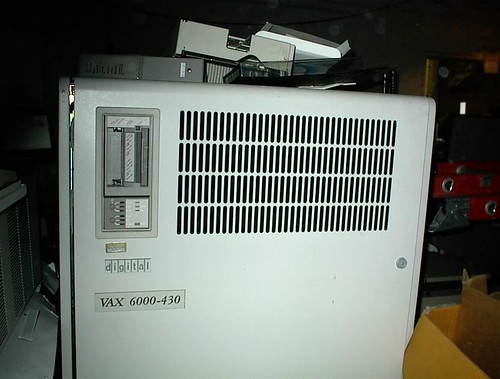
Now Loading Your Daily Vax


Today's Vax really is a 6000 series. An old beast of a machine with white metal paneling, wheels at the bottom, and a tape drive up top. This is the kind of Vax you could really make a refrigerator out of. Or a battering ram. The machine you see here is now deceased, sent off to a recycling center to be crushed up and salvaged for its base materials. Back when copper was worth lots of money, this was the right thing to do. Today, however, it would probably be better just to use it as some sort of building foundation.

Monday, November 10, 2008

Merb 1.0 Arrives


All the great things Ruby on Rails does for developers don't matter much once you really start to get used to the environment. As with any piece of software, familiarity can breed contempt, and that's why there are alternative ways of doing just about everything in the development world. Hence, the release of Merb 1.0. RoR is great for getting up and running, if you want to build a MySQL-backed Web application that will be standing alone, and working only with its own data.

Beyond that, things can get sticky. Some folks have turned to JRuby to remove constraints. Others have turned to Merb. We wrote about Merb, recently, and felt it was time to bring the story back to the front page, as version 1.0 has arrived. It's the Ruby framework for folks who don't like waiting for Rails to restart.

Friday, November 7, 2008

Monday's Linkapalooza

Naturally, Linkapalooza isn't coming out until News on Monday. But until then, I think we can allow you to sneak a peak at the forthcoming Linkapalooza. Observe:


The best thing yet found in the Android source code.

The story behind the massive network and infrastructure behind those cheap “Single?” signs on lawns.

JavaScript graph plotting tool.

50 Must read books on Web development.

Tips for preparing a technical presentation.

n introduction to Microsoft's F#

Today's Random Wikipedia Entry: Blogging!

Two Updated IDEs


This week saw the release of two major updates to two very different IDEs. The first was Komodo 5.0, ActiveState's dynamic language-focused IDE for Ruby, Python or Perl fans. Hence the dragon above. Actually, it was something of kismet here, because today, as it happens, the front page Wikipedia random entry just happened to be about the lovely green fellow you see above. Naturally, with the open copyright image therein, we just had to use him here.

The second big updated IDE is IntelliJ's IDEA 8.0, which arrived yesterday. We'll have a full story, as always, at SD Times dot com next week. But until then, here's a snippet of what we'll be saying about the release:

SQL has come home to roost in the new IDEA. JetBrains, on Thursday, November 6, released IntelliJ IDEA 8, the latest update to its popular Java IDE. But Java was hardly the focus of this release, which includes SQL query design and management tools for the first time. A new UML class browser has also been added, expanding the capabilities of this IDE beyond just Java and into the ephemeral support languages and structures commonly used in enterprise applications.

For IntelliJ loyalists, version 8 updates the core editor with new refactorings and code inspections. Also new to this version are tools for working with unit tests, and the new “dataflow to this” command. Both should help developers get a handle on confusing code when debugging.

On the framework and protocol front, IDEA 8 brings Spring support up to date with version 2.5. Included in that support is the ability to deal with Spring Dynamic Modules, all the rage of late in the component-based development crowd. Beyond that, IDEA also brings in support for Jboss Seam.

Just in time for the completion of JSR 311, IDEA also adds support for dealing with and creating RESTful Web services.