Showing posts with label tech. Show all posts

Tuesday, December 2, 2008

Inefficiency of Efficiency


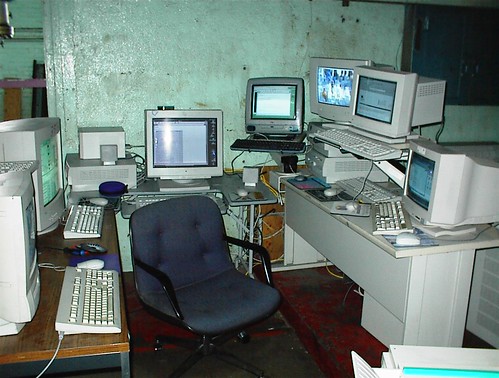
I am unable to work without two computers. I mean, I can get stuff done, and I can complete my daily tasks one a single laptop, and often have. But if I really want to crank out work and research, I need two. Maybe three. One machine for writing and email, one for Web browsing and research, and still a third for a constant stream of AIM, IRC, forums and music.
Sure, all of these could be done on the same machine, but it's just easier to look over at the screen next to me and immediately see if anyone has responded to my questions in IRC, or to see how a name is spelled on a company Website.
Switching between programs is always a pain, and on space-constrained laptops, it's not an option to spread things out to a viewable distance.
And yet, with all these computers on my desk, there is still one major problem I have yet to solve reliably: passing around URLs and quotes. Right now, I use AIM for this. I past the URL into one of my AIM screennames on the desktop machine, and message the info to another screenname on the laptop. That simple URL then travels thousands of miles to Virginia, where it is parsed and directed by AOL's servers, and sent back here to Oakland.
These computers are so close, they could touch. And yet, here I am, using the Internet as a router for my simple textual information. If I wasn't using one of each type of operating system (Mac, Windows, Ubuntu) there might be an easier solution. But until there is a cross-platform messaging standard that doesn't require a central hosted service, I will continue to use millions of dollars worth of infrastructure to accomplish tasks I could just as easily apply a sticky note and a pen to.

Wednesday, November 19, 2008

JavaFX Will be Here Soon


Sun's answer to Flex and Silverlight will arrive in the first week of December. JavaFX, formerly JavaFX Script, is set to hit version 1.0 shortly after Thanksgiving, said a spokesperson with the company. Things at Sun are a bit chaotic right now, and the release may be delayed by as much as a week if things don't come together properly. This, evidently, has less to do with the technology than it has to do with the major changes in management throughout the company. Either way, the release itself will take the form of a new installer for Java.

That new installer isn't too different from the old one: it's the basic JavaSE desktop runtime with the JavaFX libraries included. Users who already have Java installed should be able to automatically pull those packages down upon the reception of a JavaFX application embedded in either a desktop or Web app.

NetBeans is the editor of choice for dealing with JavaFX, and this morning's release of version 6.5 quietly included all of the JavaFX tooling. No patch needed.

The big selling point for Sun, right now, is that JavaFX can run browser applications and desktop applications on the same runtime. Adobe's current schizoid approach with AIR, Flex and Flash could turn out to be an Achilles heel, if you believe Sun's pitch.

The benefit to developers is less understood at the moment, because, as usual with Sun, this type of thing is entirely new. The application benefits will have to be discovered elsewhere. For now, Sun shows off an in-browser video player, and shows that it can be quickly moved out of the browser and onto the desktop.

Perhaps video is the neatest new addition to the platform, here. Java has never had an embedded video codec, and here, in JavaFX, is such a beast. It's not even proprietary: they're licensing a standard codec.

Mac users will have to wait a little bit, as the Java code there is Apple's. Sun expects Apple to add JavaFX promptly upon release, possibly even the same day.

JavaFX should be an interesting new avenue for Sun. Eventually, the company plans to offer this language on mobile platforms, and right now, the target date for that capability is next summer. The idea is to have one language to rule them all.

Wasn't that what Java was supposed to be?

Tuesday, November 18, 2008

JCP Election Results Are In

The Java Community Process Executive Committee membership election process is now over.


The executive committee of the JCP guides the guides that guide Java. It's like being on the board of directors for Java. Sort of. Some would say, not really. Either way, the JCP's EC now has four newly elected members.

Intel will be returning to its seat on the Java SE/EE executive committee, as will Sony Ericsson on the ME committee. The two not-quite new-comers are Werner Keil (below) on SE/EE and Sean Sheedy on ME (Above).

Werner is spec lead on JSR 275, the Units specification. Sean was involved in JSR 248, the mobile service architecture. He was, effectively, Nextel/Sprint's member on the EC. This year, he is independent.

Congratulations to all of the winners!

Monday, November 17, 2008

Today's Vax


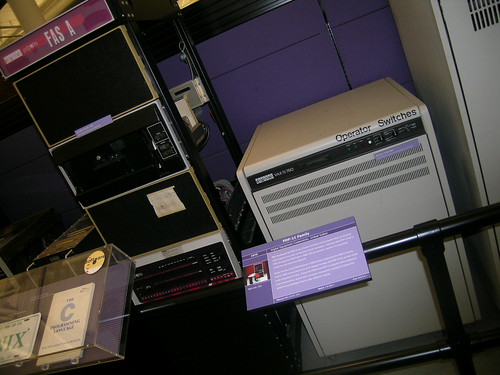
Today's Vax is from the Computer History Museum. It's an 11/750, which makes me think it's really just a PDP-11 with a different name tag. Again, I could be wrong. I only really write about these things because the Vax exemplifies the embodiment of Big Iron. I'm too young to have used much VMS.
Keep it tuned here for something truly horrible tomorrow; Vax Jousting.

Rich Green Moves to Greener Pastures


Rich Green shouldn't have much trouble getting another job. That's a good thing because Rich was recently let go from Sun, where he headed up the entire software division. Solaris. Java. NetBeans. Glassfish. Everything.

It's definitely hard to think of a more punishing, difficult job than making sense out of Sun's software portfolio. In a company where the guiding line, recently, is to open source everything, Sun still has a remarkable amount of closed source software that it supports and sells. That list has gotten shorter under Rich's reign, but it's by no means gotten any better.

Sun has always been known for writing very competent, technically advanced software that is years ahead of the curve. Unfortunately, it's also known for producing software that moves too slowly to keep up with the accepted curve of excellence. Such is the case with Solaris. Solaris users are ravenous, and can't understand how people get work done in other Unix environments. And yet, newcomers mostly stare at Solaris and ask "so, why is this better than Linux?"

It's like standing in a field of hedgerows, then picking the one quartered off field with the nicest grass, and an excellent caretaker, but only 10 feet square of space on each side.

In truth, the only way I see for Sun to move forward, away from the smoking heap of rubble that is its software portfolio, is to move closer to the consumer side. That means paying more attention to usability, simplicity, and penetration. Not exactly Sun's strong points. The Solaris faithful, of late, have had the throne of Murdock to worship at, and that's a good thing.

But is it too late for all this stuff? Maybe, maybe not. There are many other options than my consumer/power-user direction, though Sun's forthcoming release of JavaFX 1.0 could help there.

Another option is bringing the entire company together to confront the storage/database market. Sun's already offering solid-state drive arrays running ZFS, meaning RAID is no longer needed. A major advancement that's not offered anywhere else. If I were Mr. Schwartz, I'd be concentrating all firepower on that particular super Star Destroyer. Too bad EMC would be waiting at the door to kick Sun's shins and say "welcome!"

Anyway, here's hoping Rich Green finds a good company to work with. I think he'll do a great job somewhere that's a lot smaller and less troubled than Sun. It can't be easy to work at a company that seems to put all its effort into losing money.

Thursday, November 13, 2008

Daily Vaxination


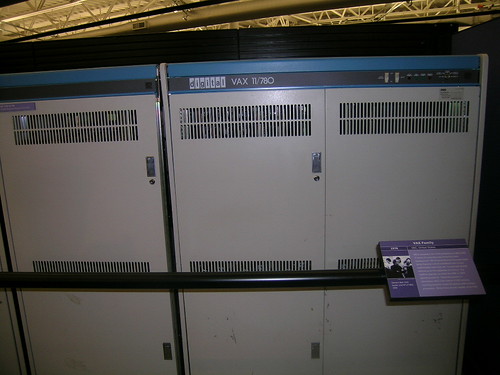
Today's Vax is an 11/780, a wall-length cabinet affair that lives at the Computer History Museum in Mountain View. It's always fun to see the big machines they wheel in there, quietly sitting, unplugged and unfunctioning, for the peoples of the world to stare at them and marvel at how far we've come. Elsewhere in the museum, they have a nifty set of Cray super computers, along with the advanced processors they created for those gargantuan machines.

Wednesday, November 12, 2008

The Vax of the Day


Today's daily Vax is of the Micro Vax variety, and the first such machine we've featured here. It's a 3, I believe, though I am probably terribly wrong about that enumeration. I do remember that starting this machine up made a sound like a jet engine spinning up. There were tons of fans in this thing, and lots of air channels and intakes. If you put your hand under the front of the thing, you could feel the sucking of the air being pulled in.

Tuesday, November 11, 2008

Now Loading Your Daily Vax


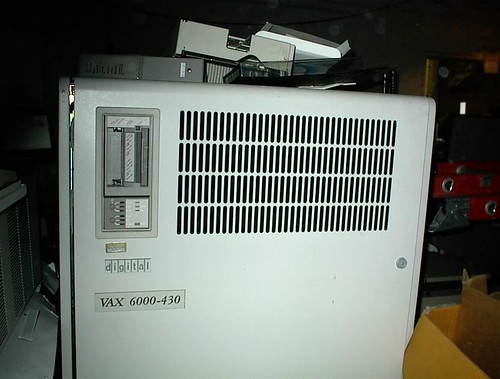
Today's Vax really is a 6000 series. An old beast of a machine with white metal paneling, wheels at the bottom, and a tape drive up top. This is the kind of Vax you could really make a refrigerator out of. Or a battering ram. The machine you see here is now deceased, sent off to a recycling center to be crushed up and salvaged for its base materials. Back when copper was worth lots of money, this was the right thing to do. Today, however, it would probably be better just to use it as some sort of building foundation.

Monday, November 10, 2008

Your Daily VAXination


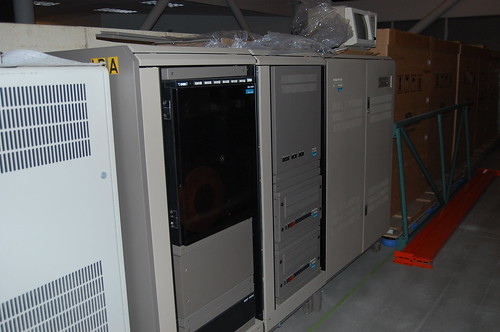
Today's Vax comes from the Computer History Museum. Someone with better eyes than mine will have to properly identify this monstrosity. It looks to me to be a 6000 series Vax, with all the trimmings of a data cabinet and an interface cabinet as well, but these things are so old, it's hard to tell, really, from this angle. Some one out there in the world, please correct my enumeration error, if in-fact I have mis-identified this Vax.

Friday, November 7, 2008

The Mother of All Mother of All Demo Celebrations

Our illustrious leader forwarded me the info on this event. It's the 40th anniversary of the Mother of all Demos. The event is in Stanford's memorial auditorium on December 9. We'll sooooo be there.

It's about as geeky an anniversary as one could possibly hope to have. In 1968, Douglas Engelbart showcased the research work that had taken place in the Augmentation Research Center at Stanford Research Institute. That meant showing off the world's first modern computing environment. It's where the world first saw the mouse, windowed work spaces, networked computing, and even hypertext. There will never be a more influential computing demonstration.

Historically, Xerox PARC gets the credit for inventing a lot of this stuff. Perhaps it would be more accurate to say that Xerox PARC perfected the ideas first shown here. Of course, the lines between the two organizations became extremely blurry as former ARC folk became PARC folk during the 70's. Note the 5-button keyboard-pad Engelbart uses in the demo. Standard issue with an Alto.


On a personal note, Bill English will be on hand to speak about the demo. I met Bill many years ago at the ACCRC, where he'd dropped in to recycle some computers. After we spoke for a half hour or so, and I gave him a tour of the facilities, he hinted that he'd been something of a technology visionary himself, back in the day.

I asked what he'd done in his youth. He told me he had built the first mouse. Forget Bill Gates and Steve Jobs. Without Bill English and the guys at Stanford ARC, we'd all be using light pens. Ick.

Enough rambling! What good is a demo without a video. Watch the Engelbart demo below. And remember, this was all done in 1968!

Thursday, November 6, 2008

Daily Vax Dosage


Doctors recommend that aging computer geeks gets their daily allotment of vitamin V. Or is that vitamin DEC? Either way, here is your daily dose of Vax: an 8600.
It sure was a beast, wasn't it? This particular beast is out of the private collection of Sellam at Vintage dot org. He runs the Vintage Computer Festival as well, but this year the event had to be skipped due to economic woes. Next year, however, there should be a great VCF, for all that have gone longing for Amiga, Atari and Amstrad enthusiasm.

Bill Joy as National CTO?


The Web is a-buzz with the rumour that Barack Obama put in a call to folks from the VC firm Kleiner Perkins Caufield & Byers, asking for CTO recommendations. National CTO recommendations. It's about time we had a leader who recognized that this nation needs a singular technological vision for government infrastructure.

The scuttlebutt on the Obama call is that Bill Joy, among others, were offered for the job. Not necessarily offered the job, but we'd imagine Obama's list would be relatively short, and Joy is perfect for the job.

Joy, as you may recall, is one of the original co-founders of Sun Microsystems. Despite that company's recent woes, there's no denying its underlying understanding of technology. Perhaps Bill Joy as national CTO wouldn't necessarily mean Open Solaris for all, but it would no doubt be something of a breath of life for the ailing company.

No matter what technology company our national CTO is affiliated with,however, it certainly seems that the Obama team is already asking the right people about the right jobs. Rah!

Wednesday, November 5, 2008

Will Oracle Miss The Cloud?


Cloud computing has arrived with such force that the concept and marketplace for it both jumped straight from the pages of theory and into buzz word territory, completely skipping the all-important "hype" phase.

It's understandable that many would look at the Cloud space and say "Whoa, that's a freakin' jungle right now. I'm going to sit this out for a bit until standards emerge."

But the Cloud is not outside the door, waiting to be let in. It's already sitting in your living room. You've unknowingly offered it some tea, and it's currently admiring your drapes.

Like Obama, Cloud computing represents hope. It's the hope that all of the traditional hang-ups of software development and maintenance can be overcome with a click or two. It's an undeniably vast space of opportunity, and one where innovation is blossoming inside Amazon, Google and VMware.

So it was strange to hear an unnamed Dutch journalist chatting about an Oracle press conference he'd recently attended. He told us, over a coffee in an unnamed conference press room, in an unnamed San Francisco hotel, that Larry Ellison got hostile when asked about cloud computing. This journalist infered that Ellison thought it was too early to worry about Cloud.

Of course, Oracle already offers its databases in Amazon's Cloud, a sure sign the company is paying attention. But it was striking to hear such talk — which, of course, we're only reporting second-hand — when only a few hours earlier, Marc Benioff and numerous other ex-Oracle salespeople were Salesforcing their way into nasty comparisons with the now ERP giant.

To look at it on the outside, Oracle is still innovating and providing great new areas for enterprise collaboration. But they're not offering anything of significance in the Software as a Service world. To our knowledge, they're not even pitching much of a fight to act as the undercarriage for Clouds. And that is undeniably the world of the future.

It's funny that Salesforce is staffed with so many ex-Oracle salesfolk, its CEO included. When listening to casual conversations over lunches and coffees, these folks couldn't keep themselves from comparing their wares to those of Oracle. And when they did, the comparisons weren't pretty at all. It's hard to rationalize buying a massive ERP installation for a single business problem, when you can get the same thing without needing an Admin for a quarter of the annual price.

So with even Microsoft making Cloudy announcements of late, it is strange to see Oracle still standing on the ground, preparing its Cloud sailboat. But hey, it is a magnificent sail boat!

The Next Mac OS Has Left the Station


Many of us here are rabid Mac users, except for those that aren't. No matter who we are, however, we undoubtedly love hearing rumors of the impending release of new operating systems. Such was the case earlier in October, when we reported that Apple's Mac OS X 10.6 had left the station in a release train.

In layperson terms, that means that all the new features, ideas and fixes for the operating systems' next release, are set in stone. That doesn't mean there won't be changes, it just means there won't be anything new added. It's a significant step in the development of any software, and for the Mac OS X, it could mean a January 09 release at MacWorld San Francisco.

And yet, no one seems to have noticed that we've written this story. We suppose it's their loss that they won't be privy to this hip, cool knowledge.